Skip to content

Drywall Service

Drywall Installation

Whether you're adding a room or remodeling, your drywall sets the foundation for everything that follows. We hang and finish walls and ceilings flat, straight, and ready for a flawless paint finish.

Drywall Installation

When You Need New Drywall Installation

  • Home additions and bump-outs
  • New construction and ADUs
  • Remodels that open up or reconfigure walls
  • Garage and basement conversions (see also Basement & Garage Finishing)
  • Replacing drywall removed for plumbing, electrical, or insulation work
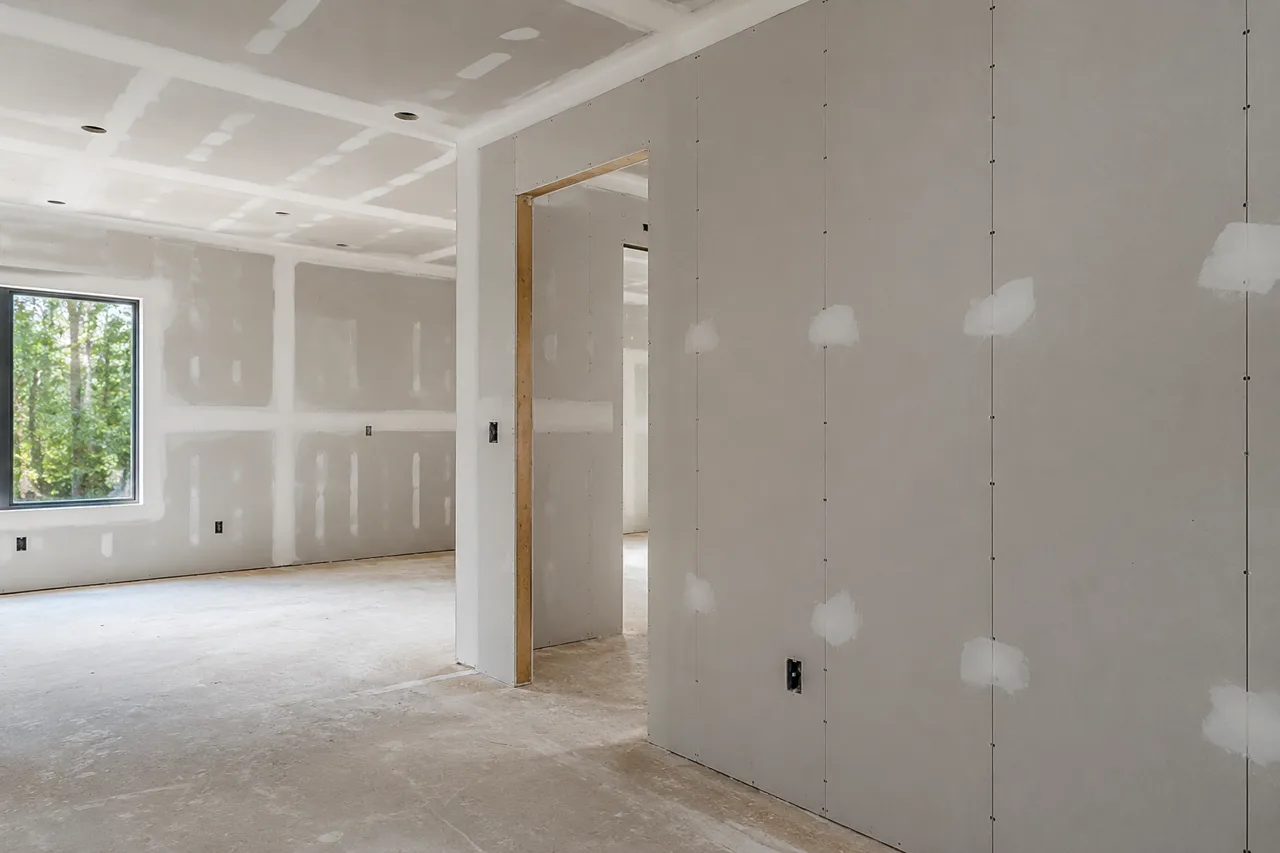
Newly hung drywall in an unfinished room — taped ceiling seams and screw dimples spotted with compound, beside a framed doorway and bare concrete floor

Drywall Installation

Our Installation Process

  1. Free estimate & measurement — We assess the space and give you a clear, no-pressure quote.
  2. Material selection — We use the right board for the job, including moisture-resistant board in bathrooms and damp areas and fire-rated board where code requires it.
  3. Hanging — Panels hung tight, square, and with proper fastening to prevent future cracks.
  4. Taping & finishing — Joints taped, mudded, and sanded to a smooth, seamless surface.
  5. Texture — Matched to your existing finish or applied fresh — knockdown, orange peel, smooth, or custom.
  6. Cleanup — Dust-minimizing methods, HEPA-filtered tools, and a tidy hand-off.

Drywall Installation

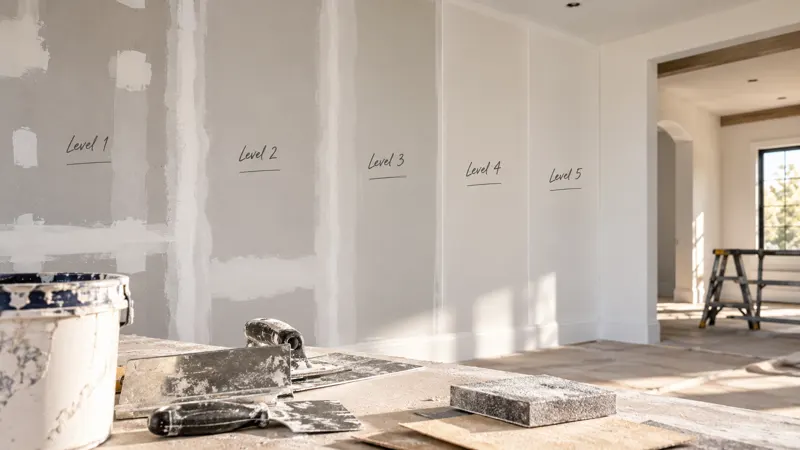
Drywall Finish Levels, Explained

Not every wall needs the same level of finishing — paying for a level you don't need is wasted money, and skimping where it matters shows the moment light hits it. The drywall industry defines six finish levels, and we finish each surface to the right one for how it will be lit and painted.

  • Levels 0-2 — tape and a coat or two over the fasteners; used in garages, storage, and areas that won't be finished living space.
  • Level 3 — two coats over taped joints; the base for heavier sprayed textures like knockdown.
  • Level 4 — three coats, sanded smooth; the standard for most walls and ceilings getting a light texture or a flat, matte paint.
  • Level 5 — a thin skim coat over the entire surface on top of Level 4; the flattest, most uniform result, and what you want for smooth walls, big windows with raking light, or a higher-sheen paint.

Drywall Installation

The Materials Behind a Lasting Install

A drywall job is only as good as what goes into the joints. We match the board and the compound to the room, not to whatever's cheapest on the truck.

  • The right board — standard 1/2-inch for most walls, 5/8-inch for ceilings and where sag or fire rating calls for it, moisture-resistant board in bathrooms and damp areas.
  • Paper vs. mesh tape — paper tape embedded in compound for the flattest, strongest joints and inside corners; self-adhesive mesh where a fast, reinforced patch makes sense.
  • Three coats of joint compound — an embed coat over the tape, a fill coat, and a finish coat, each sanded and given time to dry so the seams don't telegraph later.
  • Corner bead — metal or paper-faced bead on outside corners so they stay crisp and don't chip.
  • Drywall primer — a PVA primer seals the porous paper and compound and evens out the surface so texture and paint go on uniformly.

Drywall Installation

The Wild Fox Difference

We finish to a true paint-ready surface, then hand off to our sister team at Wild Fox Painting to prime and paint — two specialty teams, one coordinated handoff. One estimate, one schedule, one point of contact. A wall that's done when the paint dries instead of waiting on a second contractor to find and quote.

Drywall + Paint. Coordinated.

Patches that disappear, not patches you live with.

Most drywall jobs end at the wall — we finish the job by texturing, priming, and repainting through Wild Fox Painting . Two specialty teams, one coordinated handoff — no visible patch. One estimate, one schedule, one point of contact.

FAQ

Common questions about drywall installation.

We hang the panels, then tape, mud (typically three coats), and sand the joints to a smooth, seamless surface — then match or apply your texture so the walls and ceilings are ready for paint. We use the right board for the job, including moisture-resistant board in damp areas and fire-rated board where code requires it.

Yes — additions, bump-outs, full remodels, ADUs, and new builds. We hang and finish new walls and ceilings so they blend seamlessly into the existing home, texture and all.

It depends on the size of the space and the texture. Mud needs drying time between coats, so even a single room usually spans a couple of working days; a full basement is scheduled over a longer window. You'll get a realistic timeline with your written estimate.

Yes. Knockdown, orange peel, hand-texture, or smooth (Level 5) — we match your existing finish so new work doesn't stand out, or apply a fresh texture if you'd prefer a change.

Both, matched to the joint. Paper tape embedded in compound gives the flattest, strongest result on long flat seams and inside corners, so it's our default. Self-adhesive fiberglass mesh has its place for fast, reinforced patches — paired with a setting-type compound for strength.

Level 5 is a thin skim coat applied over the entire surface for the flattest, most uniform result. It's worth it for smooth walls, ceilings with big windows or raking light, and higher-sheen paint. For most walls getting a light texture and a matte finish, a Level 4 finish looks great for less.

Joint compound needs to dry fully between coats and before primer, so finishing spans more than a single day. Once it's sanded, primed, and textured it's paint-ready — and if our sister painting team is coating it, we schedule the handoff so there's no gap.

No — you don't need to be on-site while we hang and finish. It's dusty, staged work, so we protect the space, keep it contained, and coordinate access with you, with flexible scheduling to fit the rest of your project.

Planning a project? Let's talk.

Free, no-pressure estimate. Call, text, or send a few photos.

Call Get Estimate